Wednesday, 15 August 2012

Lock Down

This past weekend I intended to take Bluster out for a little sail but other things came up so instead I used a little of my free time to address some mods and maintenance issues.  I guess it is the boat builder in me but I really enjoy puttering and fussing on and around my boat.  Almost as much as sailing - a sentiment I have heard from other builders too.

A couple of years ago I purchased a lock set to enable me to secure the Bluster's cabin.  Today I finally got around to it.  Fairly straight forward jot that involved drilling a 3/4" hole in the top drop board, inserting and bolting up the lock set then attaching a cleat on the underside of the hatch.


Lock set 

Lock set intalled

Inside - unlocked
 
Inside - locked

The finished job looks good and works well.  It would not deter a determined thief but may reduce the chances of 'crimes of opportunity'. 

Now, where did I put the key?

Tuesday, 7 August 2012

On the Lazy River

I have been recently storing Bluster at a tidy little marina on the Pitt River.  What is really great is that I can leave her rigged and ready in the secured lot and then use the adjacent launch ramp to access the river.  The Pitt River is actually fairly short (connecting Pitt Lake to the Fraser River) and does not have much of a current.  What makes both Pitt River and Pitt Lake unique is that, being so close to the sea, they are both affected by the tides.

This past weekend we launched around 0800 hrs and spent a very leisurely cruise up the river to its confluence at the lake.  This is a voyage of about 15 km, the water was flat and the air windless.  We were also experiencing a bit of a heat wave in southwest BC with temperatures into the low 30 degrees.  For the most part the Pitt River is contained by dikes that have turned much of the 'polder' land from swamp to agricultural land.  There is still a great deal of wet lands and we were impressed by the bird life - herons, eagles, ospreys, geese and more.  A prominent little hill along the way is being systematically eroded away by a gravel mine. 

On the chart I noticed a little basin connected to the main river by a tight canal.  With Lisa on the bow we were able to negotiate the weeds to explore its deepest corners. 

At the entrance to the lake proper (Grant Narrows) we finally felt a bit of a northerly wind.  This was our planned turn around for the day so we raised the mainsail and enjoyed a good run down the river.   We used this time to give Bluster a good wipe down of the accumulated storage grim and dust.

Eventually the expected afternoon southerly winds made their appearance so we furled the mainsail and motored back to the ramp, arriving there around 1400 hrs.  It was getting very hot by this time and the river was getting busy with all the power boats and jet skis.   A nice outing and an opportunity to visit an area I have never explored before even though it is almost in my back yard.

Some photos...

Cottages - nice location!

Looking north towards Pitt Lake

Doing the African Queen thing

Picking a route through the weeds

Getting hot

Gravel works off the bow

Getting in a little sailing

Busy but efficient ramp

Monday, 6 August 2012

Iron Wind - Honda 5 hp Outboard

I love my 5 hp BF5 Honda outboard motor.  After ten years of yeoman service this engine has never let me down and fires up on the first or second pull even after sitting for months.  As a lad my brother and I fiddled around with the family collection of ancient and balky 2 stroke Evinrude outboards.  Based on these early experiences I decided during my boat build that if I ever completed the thing I would reward myself with a new four stroke engine.

Shiny and new

The outboard was in fact purchased during the build and I modified the transom to fit it.  This motor comes in  either a regular or long shaft version and I opted for the regular one as the leg, when in the run position, was no deeper than the shoal rudder on the Chebacco.  My thinking for this was that tucked up like this the expensive engine would not be the first part of the boat at the scene of a grounding.  I was concerned that the prop may not be deep enough for maximum efficiency but this has not been the case.  The downside of this is when in reverse the wash is directed onto the rudder and a firm hand is required to keep tiller from slamming over.


Clamped on like it belongs there

The Honda is very miserly in the fuel consumption department and is nice and quiet as well.  One criteria I felt important for the outboard was a remote fuel tank.  I know from experience the limited integrated tank capacity can let you down just when  it is needed if not carefully monitored.  The well between the cockpit and transom I designed to fit two of the 12.5 litre (3 gal) remote tanks.  In practise I only carry one.

The prop was replaced with one more suited to pushing a displacement hull resulting in a half knot speed improvement.  Half throttle pushes Bluster along easily at five knots and opening  it all the way only grain another half knot or so so I rarely go there.

If I realistically looked back on the time spent on the water since launching Bluster back in 2002 as memorable as the sailing times were, we probably spent as much or more time motoring.  Investing in a good outboard, for me, was money well spent.


No wind, no problem


Saturday, 2 June 2012

Fib - The Puff Wheat Boat Story

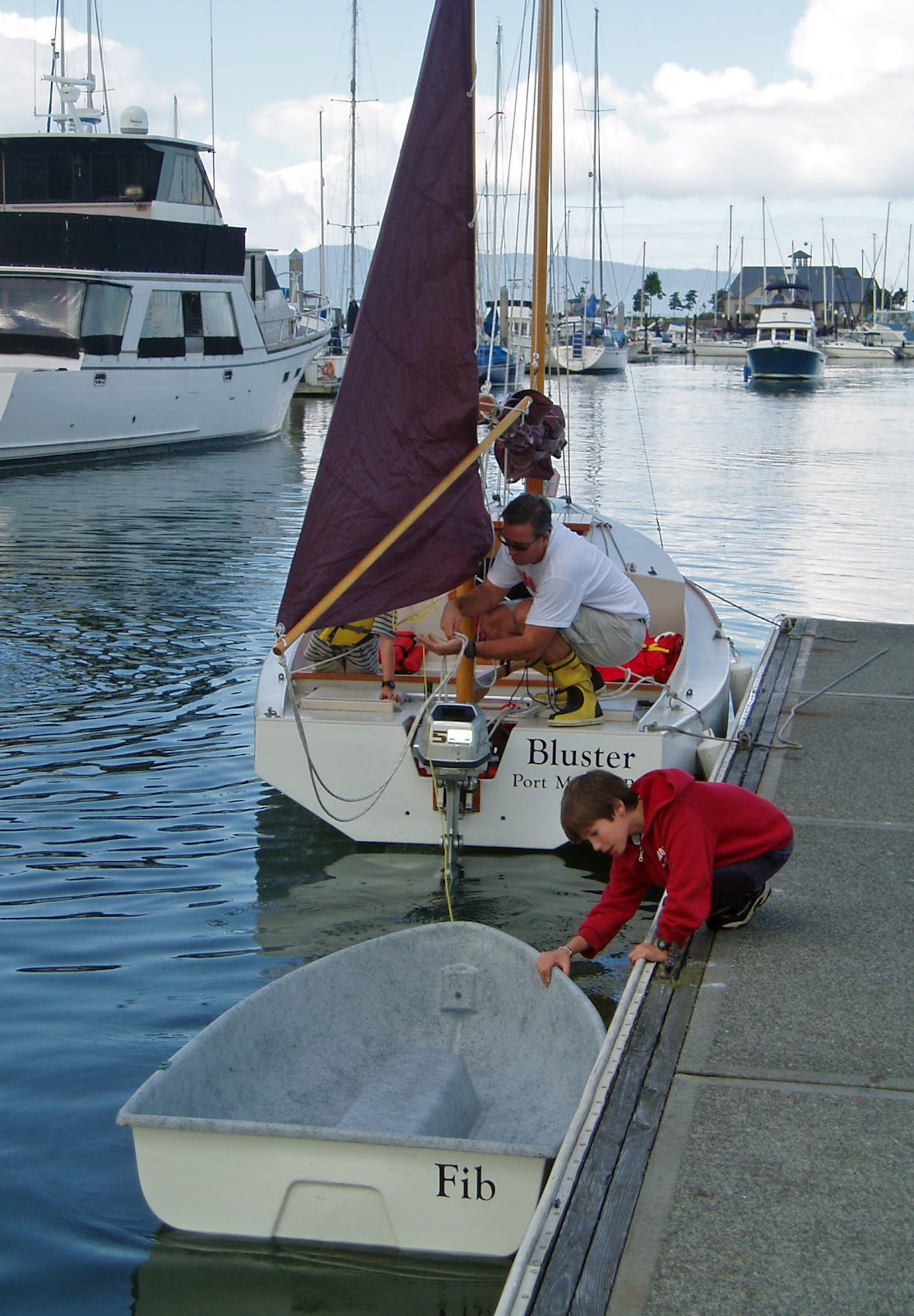
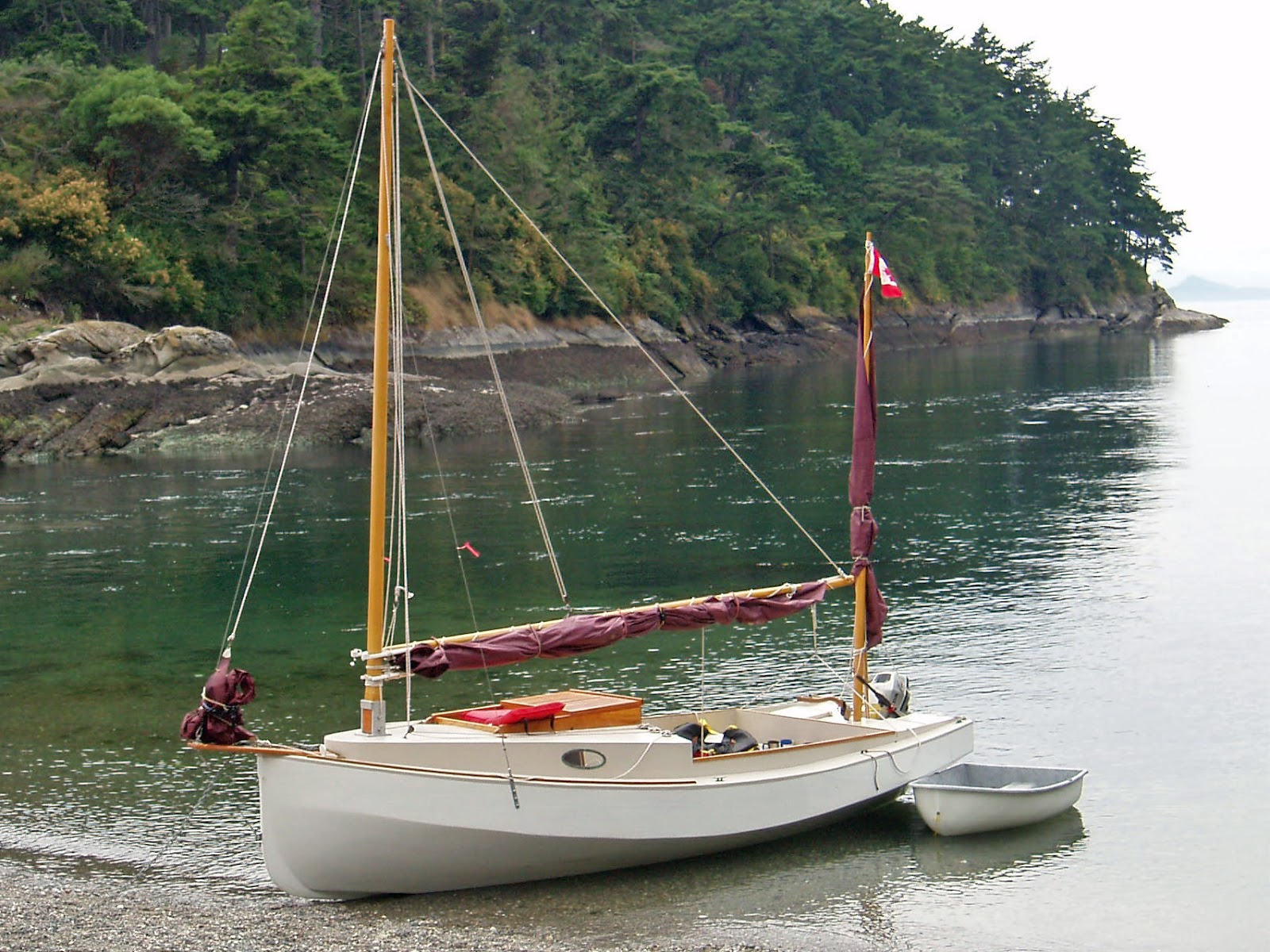
As with all sailors, at some time or another we will want to put ashore.  No tides and a sandy beach, no problem. With Bluster’s light weight and shallow draft we just pull her up on the beach and maybe drop the anchor or tie up to a handy tree. 

Crystal Beach on Kootenay Lake

The problem is when I want to anchor out I needed a dingy or tender to get ashore.  A rigid hull tender that is large enough to ferry two persons I always thought would look disproportionally large when towed behind a 19.5 foot sailboat. Also because Bluster is primarily a trailer sailor there is the issue transporting the large, awkward tender.  An inflatable dingy could be an answer and a popular option for some small boat sailors.

In the 1960s my father-in-law started up what was to become a very successful industrial fibreglass manufacturing company.  In the early days of the company no jobs were too small.  They were approached be a breakfast cereal company to manufacture a number of child sized fibreglass rowboats.  These would be distributed to grocery stores throughout western Canada.  As a promotion the boats were filled with Puffed Wheat Cereal and customers would guess the number of puffed wheat and the closest to the actual number would win the boat!

Kid sized

Our family always had a couple of well worn "Puff What Boats" as they were call at the cottage for the kids to play around with.  This got me thinking that this little boat would be the perfect size for a rigid Chebacco tender.  Unfortunately unless you are expecting to go a swim there it has a very strict two kids or one adult capacity rating.

Puff Wheat Boats

The original molds were still hanging around so I made up a nice new PWB for my Chebacco.  My wife suggested that because our Chebacco has the slightly arrogant name of Bluster that the little PWB should have an equally boastful name of "Fib".

Bellingham Harbour 

Fib, with her short waterline and flat bottom does not track worth a fig but with a little practise and a light hand on the five foot oars she will get you across the anchorage and back.  She she is small enough to travel in Bluster's cockpit while on the road and I can hoist it onto my back, coracle or turtle style, to carry across the beach. .

Now if the situation arises I can drop off any passengers or crew ashore then anchor out and use what is very likely the smallest true production fibreglass boat in the world to get ashore. 

 Puff Wheat Boat Statistics:
  • Length:  5'6"
  • Beam:    3'6"
  • Draft:     0"1"
  • Capacity: 200 lbs
  • Designer Unknown
  • Manufacturer: Marine Plastics Ltd. 

Fib in action...
Sucia Island (John Kohen photo)

"Time out" in Fib

Light enough for an exhausted wife and nine year old to carry
 
Sucia Island


Tuesday, 10 April 2012

Maintenance and The Need to Vent

We were blessed with a lovely sunny Easter weekend on the the Sunshine Coast that allowed me to get some minor maintenance and modifications done on Bluster.


The gaff boom had been removed to redo the jaws and touch up the varnish.  This was laced back onto the sail and the halyards attached.  I was amazed with this mess of lines I had no serious tangle issues.  Lots of spider nest to brush off the sails.

When spending any time 'below decks' it was obvious there is very poor air circulation.  The companion way boards and hatch can be opened but without another opening to the outdoors air flow is minimal.  To address this I purchased a Sea Dog 3" low profile cowl vent with jaunty red interior.


The stressful issue here was determining where to cut the hole and I decided to locate it within the companionway frame.  This spot is protected from deck action and would not interfere with the sliders as the hatch is never pushed that far forward.  A 3.75 inch hole was drawn out and my trusty jigsaw did the rest.


The cut was then cleaned up with 180 grit sandpaper and the raw plywood sealed with epoxy.  Silicone sealant was applied to the vent base and this was then attached to the cabin top with stainless screws.


The vent was then attached to the base and when I went below a fresh breeze was detectable from the slight wind above.


Saturday, 10 March 2012

Not Really Marine Equipment, But Useful On A Small Sailboat Post #4


Big Sky Bistro Coffee Press


If you like fresh coffee in the out of doors this is a really useful rig.  It is basically an insulated mug with a lid and a coffee press.  Just add the ground coffee to mug, top up with boiled water and stap on lip with press in the up position.  Let sit for a spell then plunge the press to the bottow and viola, coffee.  I like that the mug is insulated and the lid has a little hole so that the java can be sipped directly.  The 16 oz. capacity provides for plenty of coffee to share if you like.   Without the removable press it makes a reasonalble tea pot and and the mug alone is just fine sipping cold brews as well.  Cheers.

http://www.mec.ca/AST/ShopMEC/HikingCamping/CookwareUtensils/CaffeineCreators/PRD~4008-946/big-sky-bistro-coffee-press.jsp

$14.00

Gaff Business

I did not 100% followed the original Phil Bolger drawings when I built Bluster.  Most of the deviations involved raising and widening the cabin, changing the stern cut away and adding a mast tabernacle.  In hind sight, all good ideas.  One item I considered changing but did not is the straight style gaff horns (fork?).


The straight ones are easier to build but do not work as well or look as "gaffy" as the curved style.  This retrofit was on my to do list for this year.  


I started by cutting away the straight horns but leaving the base, where the one piece original horns were attached to the gaff.  


The new horns were cut out of 3/4" plywood and glued into place.


Epoxy sealing and a couple of coats of Interlux Brightside Polyurathane White.
Job done. Tick.


In place, working fine and looking good